
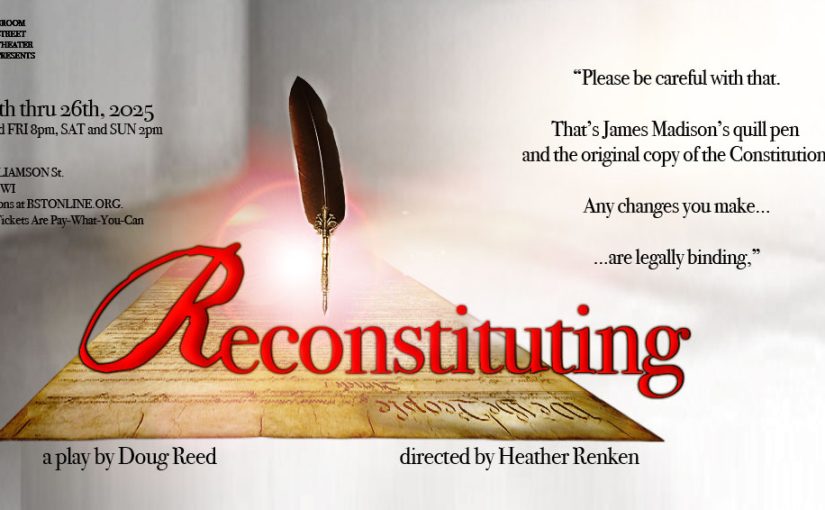
Written by Doug Reed
Directed by Heather Renken
Cast & Crew Credits / A Note From The Playwright
The Cast
Doug Reed: Doug Reed
Benjamin Franklin: Misha Latyshev
The Chorus:
Hawa Bah
Sean Cairns
Amy Rowland
Alyssa Stowe
Understudy for Doug Reed: Bob Moore
The Crew
Director: Heather Renken
Stage Manager: Hobbes LeGault
Lighting Design: Christa Dahman
Costume Design: Susan Shoemaker
Sound Design: Brent Holmes
Props: Stephanie Albrecht
Percussion Backing Track: Autumn Maria Reed
Set Painting: Meaghan Heires
Poster Design: Rob Matsushita
Dr. Franklin Design & Construction: Steve Troop
Dr. Franklin’s Wardrobe: Laurie Everitt
Charles G. Dawes Design: Beau Haven
Charles G. Dawes Printing: Chris Meyer, Sector 67
A Note From The Playwright
Because this is America, I’m going to do one bit of crass commercialism before I talk about the art.
This play is based on a book that I started writing the day the Dobbs decision came down, and finished shortly after this past Inauguration Day. If you enjoy the play, then you’re probably saying to yourself – can I buy a copy of the book at the box office?
No.
Because I can’t distinguish between “days” and “business days”, the book isn’t back from the printer yet. Shortly after this play closes, I’ll get that big stack of copies I planned to sell at the box office. Click here to let me know if you’d like one, and we’ll work something out when the copies finally arrive.
There. That’s the crass commercialism out of the way. Now let’s talk about the play.
This isn’t a play about current events. It’s a play about hope.
It may be naive to write a play about hope in these times. The Constitutional outrages that have happened between the start of rehearsal and tonight are staggering. I could write a whole nother play just based on the last few weeks. But I still believe that hope is one of the most powerful weapons we have. As the Doug character says in the play- Dum spiro spero. (It’s Latin for “While I breathe, I hope”.)
I grew up in the ’70s. It’s hard to tell you how cool the 1976 Bicentennial was to a history-obsessed kid. Towns painted their fire hydrants into little Continental Minutemen. Betsy Ross flags were everywhere. We were raised on Schoolhouse Rock – learning to sing the Constitution’s preamble, that we’re a great American Melting Pot, that we were suffering before suffrage, and most importantly that a Bill is only a Bill while it’s sitting there on Capitol Hill.
Of course I was a white kid in a white suburb, and there was another America I knew nothing of. (Actually, I grew up in Richmond, VA – capitol of the Confederacy – and was raised on a gauzy Gone With The Wind version of Civil War history that would make you retch.)
Critical as I am of my upbringing now, it felt idyllic then. And I grew up deeply in love with my country. The best of my country. The mosaic of jaw-dropping natural scenery. The glorious jazz, blues, country, R&B, zydeco gumbo that makes our music. The belief that anyone from any country can come here, and with hard work can make a life for their descendants. The America of Lincoln’s sublime Second Inaugural – with malice toward none, and charity for all. The America where the struggles for Civil Rights, Women’s Rights, Native American Rights, Labor Rights, LGBTQ Rights eventually yield (slow, costly, painful, imperfect) results – and the arc of the moral universe really does bend toward justice.
I choose not to believe that America is gone forever. I still deeply love that America.
The play you’re about to see reflects that love. My wish that we can reset. My wish that we can make this a country – a just, humane country – worthy of having the next generation of kids fall in love with.
Oh, and one personal note, just because I’m self-conscious about this part.
This is a play by Doug Reed, starring Doug Reed as a character named Doug Reed. I know what you’re thinking. You’re so vain. You probably think this play is about you.
I can explain. This isn’t just my monstrous ego run amok.
The more I worked on writing this play, the more I realized that the fictional character of the Tourist isn’t fictional at all. He’s me. These don’t feel like the times to hide behind a wall of theatrical artifice. These feel like the times to plainly state “This is me. Here I stand. This is the America I believe in.” That’s why I chose to make myself the protagonist.
Oh, and one more thing on a personal note…
To the cast and crew and especially Heather – thank you. Thank you for believing in this play and bringing all your skill and your craft and your art to this production. I am blessed and humbled that you’ve all chosen to believe in this project.